

"The algorithm hates me" is probably the most common complaint on Instagram. The truth is less dramatic and more useful: there isn't one Instagram algorithm, there are several ranking systems, and each one predicts what a specific viewer will find worth their time. The three signals Instagram says matter most are watch time, likes and sends. Once you understand how those signals work on each surface, most reach problems start to make sense.
There is no single "Instagram algorithm"
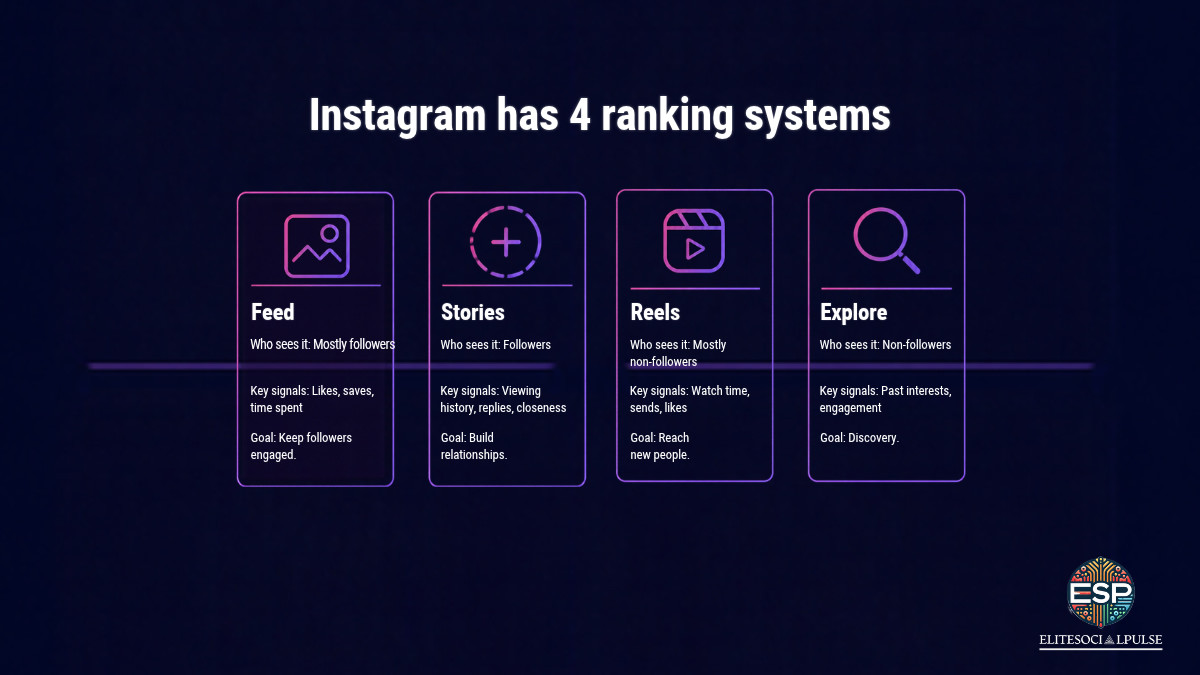
Instagram ranks content separately for each part of the app. Feed, Stories, Reels and Explore each have their own ranking system, because people use them for different things:
Feed: mostly posts from accounts you already follow, mixed with suggested posts.
Stories: almost entirely accounts you follow, ordered by how close you seem to be to them.
Reels: mostly content from accounts you don't follow yet. This is where new people discover you.
Explore: a personalised grid of content from new accounts, based on what you have engaged with before.
So when someone says "my reach dropped", the first question is: reach where? A drop in Stories views and a drop in Reels reach usually have completely different causes.
The question every ranking system asks
For each viewer, Instagram predicts how likely they are to take certain actions on a piece of content, then shows them what it expects they will value most. Instagram's head, Adam Mosseri, has named three signals that carry the most weight: watch time, likes per reach and sends per reach (shares in direct messages). Comments, saves and profile taps also play a role.
"Per reach" matters. Instagram is not counting raw likes; it looks at how many of the people who saw your post actually liked or sent it. A small account whose posts get sent often can outrank a big account whose posts are scrolled past.
Think of it this way: Instagram is not judging whether your post is "good". It is guessing whether this particular person will stop, watch, react or pass it on.
Followers vs non-followers: why signals weigh differently
The same three signals do not count equally for every audience. According to Mosseri, watch time is the most important signal for both groups. For people who already follow you, likes are slightly more important than sends. For people who don't follow you yet, sends are slightly more important than likes.
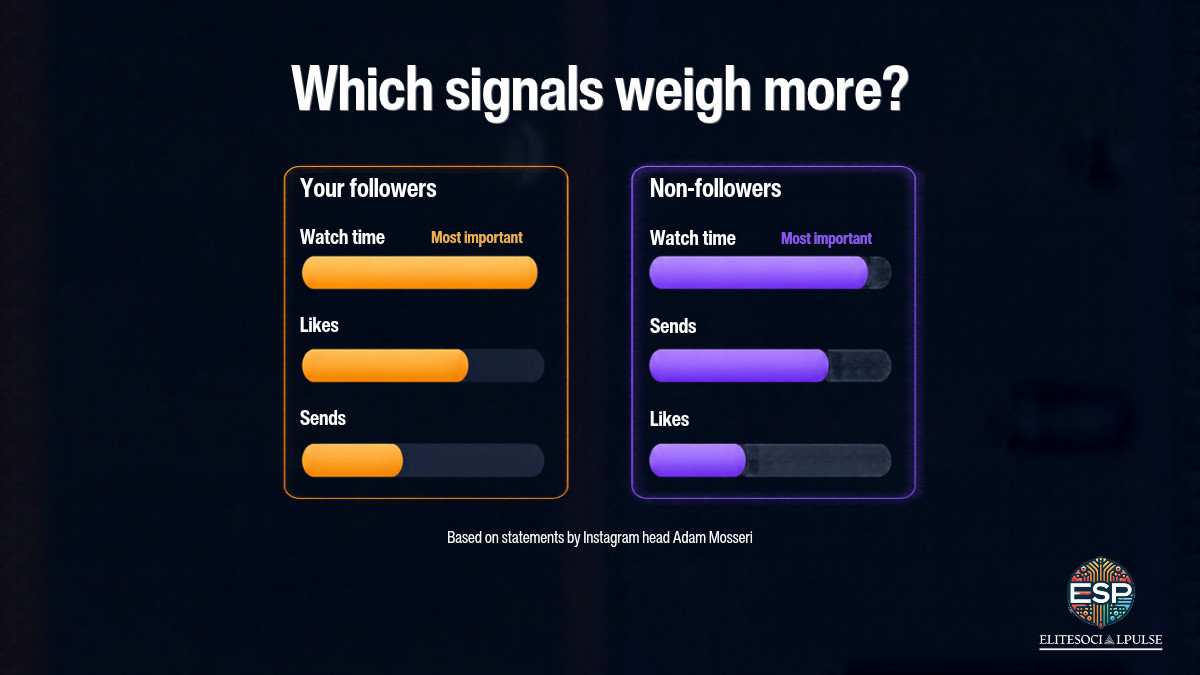
In practice this means you need two kinds of content. Posts your followers enjoy and like keep your Feed and Stories healthy. Content people want to send to a friend is what carries you to new audiences through Reels and Explore.
The signals that matter most
Watch time. For Reels and video, how long people keep watching, and whether they rewatch, is the strongest signal. A short Reel people finish beats a long one they abandon.
Sends. When someone shares your post to a friend in DMs, it is one of the clearest signs that content is worth spreading, especially for reaching non-followers.
Likes. Still important, particularly in Feed, where they reflect how much your existing followers enjoy your content.
Comments and saves. Comments suggest conversation; saves suggest lasting value, such as tips or guides people want to come back to.
Relationship signals. In Feed and Stories, how often someone interacts with you, views your Stories or visits your profile affects whether you appear near the top for them.
Originality. Instagram has said it prefers original content and may limit recommendations of reposted material, especially clips carrying other apps' watermarks.
Viewers can now steer their own recommendations
Instagram's "Your Algorithm" feature shows people the topics Instagram thinks they are interested in and lets them add or remove topics. It started with Reels and is now available across Feed, Reels and Explore. When a viewer changes their topics, recommendations update everywhere.
For creators, this makes a clear niche more valuable than ever. If people can actively ask for "more fitness" or "less celebrity news", accounts that sit firmly inside a recognisable topic are easier for the system to match with the right viewers.
Myths that waste your time
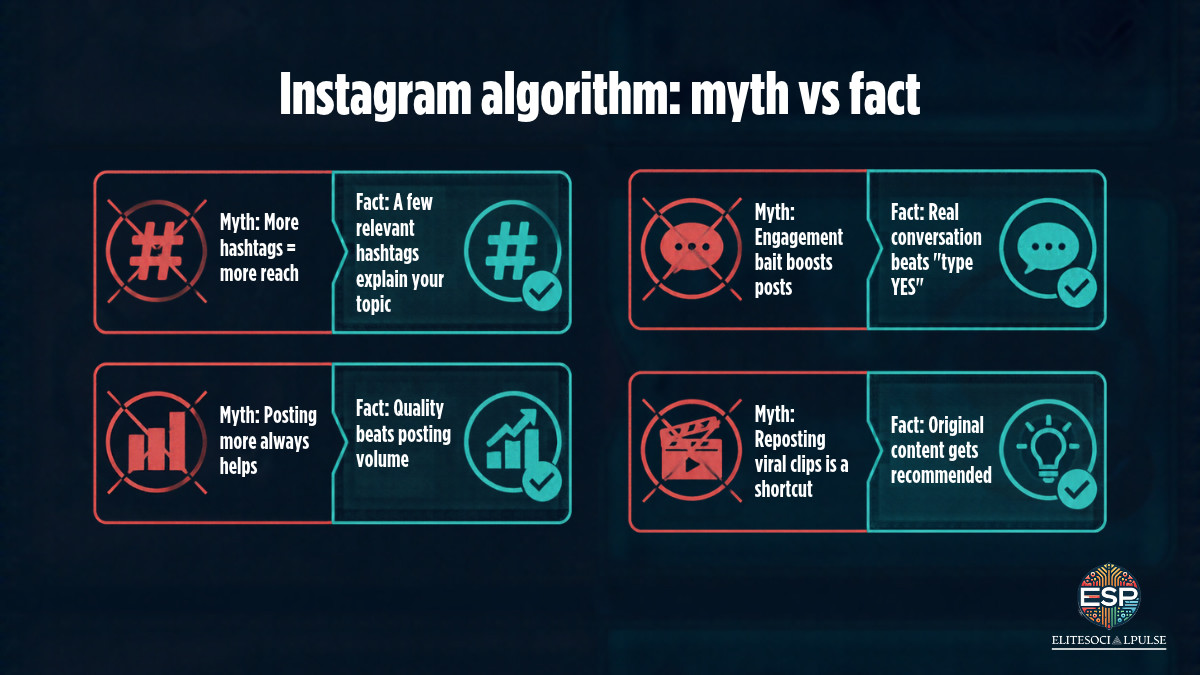
"More hashtags means more reach." A few relevant hashtags help Instagram understand your topic. Long lists of generic ones do not create reach, and Instagram now limits how many a post can carry.
"Engagement bait works." Posts that beg for comments ("type YES if you agree") are easy for platforms to spot and are not a reliable growth tactic.
"Posting more always helps." Volume without quality spreads your audience's attention thin and lowers your per-reach numbers.
"Reposting viral clips is a shortcut." Recycled content with other apps' watermarks is exactly what Instagram says it may show less.
A practical playbook for each surface
Reels: reaching new people
Hook viewers in the first 1–2 seconds: show the result, ask a sharp question or start mid-action.
Keep it as short as the idea allows. A tight 15-second Reel that people finish beats a slow 60-second one.
Make it worth sending: a tip a friend would need, a joke for a specific group, a "this is so you" moment.
Use on-screen text, because many people watch without sound. Trial Reels let you test a Reel on non-followers first.
Feed posts: keeping followers engaged
Carousels with useful, step-by-step information tend to earn saves.
Write captions that add context instead of repeating the image.
Reply to early comments; conversation in the first hour helps show the post is worth surfacing.
Stories: building relationships
Use polls, question boxes and quizzes. Each tap is an interaction that strengthens your connection with that viewer.
Post consistently enough that your audience expects you, without flooding them.
Your account overall
Stay in a clear niche so Instagram learns who to show your content to.
Check Insights weekly: reach from non-followers, average watch time on Reels and which posts were saved and sent.
Avoid behaviour that looks automated or spammy, such as mass following and unfollowing.
Where do SMM services fit in?
Social proof affects how people react. A new profile with a handful of followers and likes can look untested, even when the content is good. Some creators, brands and agencies use SMM services to give a new account or campaign a stronger starting point, so real visitors are more willing to watch and follow. If you are new to how this works, read What Is an SMM Panel? first.
Be realistic: services can support visibility, but they cannot replace the signals above. Watch time, sends and genuine conversations still come from content people care about. The healthiest approach is gradual, natural-looking support on top of a solid content plan, never instead of one. The same principle applies on other networks, as we explain in our guides to LinkedIn followers and Snapchat followers.
If you run an agency or panel and want reliable services through an API, our API page shows how the integration works. Accounts are opened on request, so message us on Telegram to get access.
Frequently asked questions
What is the most important ranking signal on Instagram?
Watch time. Instagram says it is the most important signal for both followers and non-followers, followed by likes per reach and sends per reach.
Does Instagram show my posts to all my followers?
No. Feed and Stories are ranked for each follower based on their interests and how often they interact with you, so different followers see your posts in different positions, and some may not see them at all.
Do hashtags still help on Instagram?
A few relevant hashtags can help Instagram understand what your post is about. They are not a reach lever on their own, and long lists of generic hashtags do not improve distribution.
Why did my Reels reach suddenly drop?
Usually because recent Reels held attention for less time or were sent less often. Check average watch time and sends in Insights, compare them with your best Reels and look at the first two seconds of each video.
What is "Your Algorithm" on Instagram?
It is a feature that shows viewers the topics Instagram thinks they like and lets them add or remove topics. Changes apply across Feed, Reels and Explore.
Final thoughts
The Instagram algorithm is really a set of predictions about what each person will find worth their time. Make content that holds attention, gives people a reason to send or save it, and builds real relationships, and the ranking systems tend to work in your favour rather than against you.
Written by the Elitesocialpulse team. Last updated: 27 November 2026.
Related reading: What Is an SMM Panel? How It Works and Who It's For